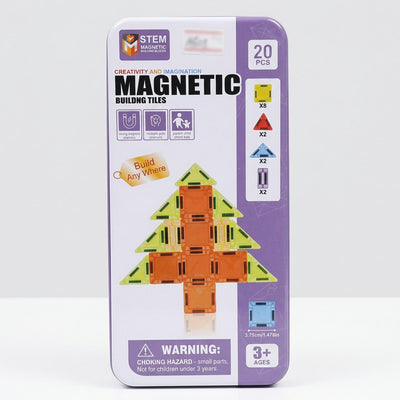
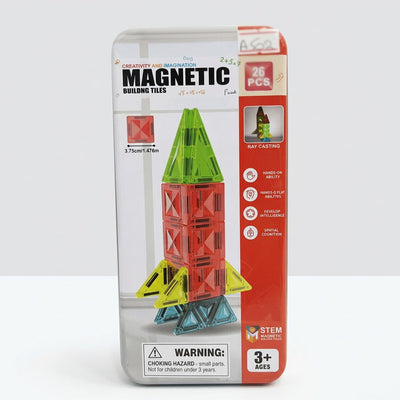
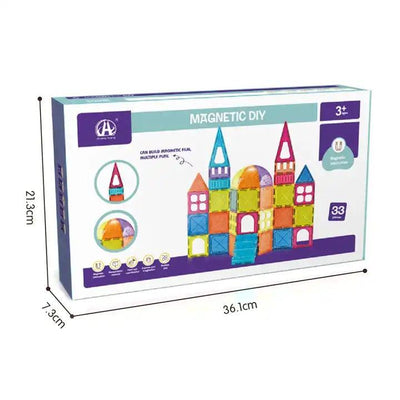
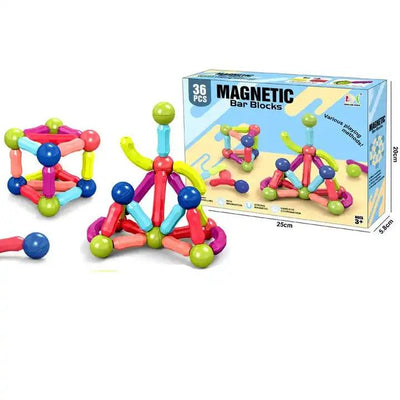
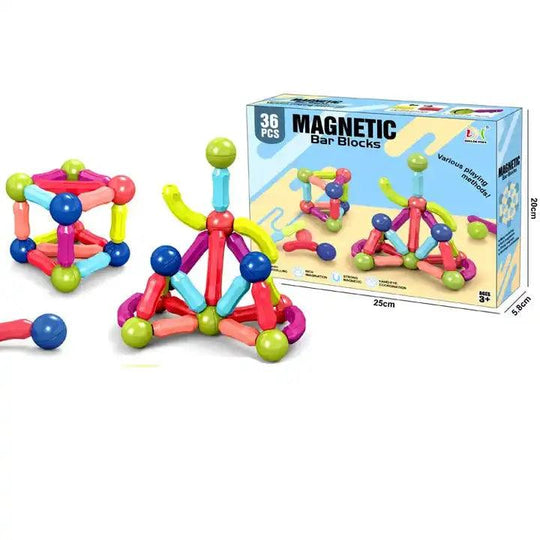
The short answer: buy magnetic tiles if your child is 3 to 5 and gets frustrated easily, because the tiles snap together on any edge and big shapes go up fast. Buy magnetic bars and balls for a child who already loves building and wants 3D frames like cubes and pyramids. Buy interlocking building blocks if you want the most pieces for your money and lots of cars and small models. All three are rated 3+ because they contain small parts.
"Magnetic" is the single most searched word on our website. Below is what each type actually does, using sets we have in stock today.
Quick picks
| Set | Type | Age on box | Price | Why |
|---|---|---|---|---|
| Magnetic Building Tiles, 20 pieces | Tiles | 3+ | Rs 2,000 | The cheapest way to see if your child likes magnetic building. |
| Magnetic Tiles, 26-piece Rocket Set | Tiles | 3+ | Rs 2,500 | Comes with a rocket to copy from the box, a good first "goal". |
| Magnetic DIY Construction Set, 33 pieces | Tiles | 3+ | Rs 5,250 | Arches, windows, a dome and roof pieces for castles and houses. |
| Magnetic Building Bar Blocks, 36 pieces | Bars + balls | 3+ | Rs 2,825 | Builds 3D frames, and some bars bend into curves. |
| 170-Piece Building Blocks Bucket | Interlocking blocks | Small parts warning | Rs 4,150 | 170 pieces with wheels for cars. The bucket doubles as storage. |
| Magnetic Tangram Puzzle Book | Magnetic puzzle | Small hands | Rs 1,675 | 7 wooden magnetic pieces and 96 patterns, and it folds shut for travel. |
Prices checked on the site on 30 October 2026.
What are magnetic tiles, and who are they for?
Magnetic tiles are flat plastic shapes (squares, triangles, rectangles) with magnets sealed along their edges. Hold two tiles near each other and they click together. There is no peg to line up, so a 3 year old can build a wall, then a box, then a "house" in minutes.
The tiles in our 20-piece and 26-piece sets measure 3.75 cm across and are see-through, so a finished tower glows when light comes through it. The bigger 33-piece DIY set adds arched windows, a doorway, roof pieces up to 13.5 cm and a clear dome, which is what turns "a box" into a castle.
most children build a house first. then they knock it down. then they build a taller house.
How are magnetic bars different?
Magnetic bars and balls build frames, not walls. Each bar attaches to a steel ball from any angle, so children make cubes, pyramids, towers and animal outlines in three dimensions. The 36-piece bar set includes some bendable bars for curves.
Bars need a bit more planning than tiles because a frame collapses if it isn't braced. That makes them great for a 5 or 6 year old who already likes building, and slightly frustrating for a younger child on their own. Play together for the first few builds.
Are ordinary building blocks still worth buying?
Yes. Interlocking blocks give you the most pieces per rupee and are better than magnets for small detailed models. The 170-piece bucket includes pieces with wheels and axles already fitted, so cars and trucks are the first thing most children build. It packs into a lidded bucket with a handle, which matters more than it sounds when the pieces are all over the floor at bedtime.
For children under 3, skip small blocks and choose large soft blocks from our 1–2 years collection instead.
Which one helps with learning?
All three are open-ended building toys. Children decide what to make, then work out how to make it stand up. While they build they handle shapes, sizes, balance and counting without anyone giving a lesson. The American Academy of Pediatrics' report The Power of Play (2018) describes this kind of self-directed play as important for problem-solving and executive function. We are a toy shop, so we will just say this: building toys are the ones we see children come back to month after month.
If your child likes shapes more than building, the Magnetic Tangram Puzzle Book (Rs 1,675) is a quieter option. Its seven wooden pieces stick to a magnetic board, it has 96 patterns to copy, and it closes like a book for the car.
Are magnetic toys safe for children?
Magnetic tiles and bars are safe when the magnets stay sealed inside and the toy suits the child's age. Two rules matter:
- Follow the 3+ rating. Our tile and bar sets print a choking-hazard warning, and the balls and bar ends are small.
- Throw away a cracked piece. If a tile splits and a magnet comes loose, bin it. Doctors' groups, including the North American Society for Pediatric Gastroenterology, Hepatology and Nutrition, warn that swallowing more than one magnet is a medical emergency, because the magnets can pull together inside the gut. If you think a child has swallowed a magnet, go to a hospital straight away.
How many pieces do you need?
For one child aged 3 to 4, 20 to 36 pieces is enough to start. Children who build every day run out of pieces at around 6. That is the time to add a second set, and sets of the same tile size usually work together. A 33-piece set with roof and window pieces gives far more variety than doubling up on plain squares.
How ordering from Little Explorers works
- Cash on Delivery across Pakistan. No card needed.
- Delivery: Rs 200 on orders under Rs 5,000, and free on orders of Rs 5,000 or more.
- How fast: Islamabad and Rawalpindi in about 24 hours, Karachi in 2–3 working days, and the rest of Pakistan in 3–5 working days.
- Wrong or faulty item? WhatsApp us within 7 days of delivery and we'll exchange it. We don't give cash refunds, and refunds are given as a store voucher.
- Rated 4.9 out of 5 by more than 140 customers.
- Questions? WhatsApp 0329 5118418.
Questions parents ask
What is the difference between magnetic tiles and magnetic blocks?
Magnetic tiles are flat panels that click together edge to edge to make walls and solid shapes. Magnetic blocks or bars are rods that join to steel balls to make 3D frames. Tiles are easier for 3 to 4 year olds, and bars suit children who already enjoy building.
What age are magnetic tiles for?
The magnetic tile sets we sell are rated 3+ and carry a choking-hazard warning. Children under 3 should use large soft blocks instead.
How much do magnetic tiles cost in Pakistan?
At Little Explorers, a 20-piece magnetic tile set is Rs 2,000, the 26-piece rocket set is Rs 2,500 and the 33-piece DIY construction set is Rs 5,250 (prices on 30 October 2026).
Are magnetic toys dangerous if swallowed?
Yes. Swallowing more than one magnet can cause serious internal injury and needs urgent hospital care. Keep sets away from under-3s and throw away any cracked piece.
Do different magnetic tile sets work together?
Usually, if the tiles are the same size and shape system. Our 20-piece and 26-piece sets both use 3.75 cm tiles.